People use these three names as if they were interchangeable. They are not, and the Turkish bath vs sauna comparison is where the confusion usually starts, because a Turkish bath is not really a room you sit in at all. It is a washing ritual that happens to take place in a warm, steamy room, with someone else doing the work.
A sauna is dry and hot, while a steam room is wet. A Turkish bath, or hammam, is heat plus water plus a scrub plus a foam wash, in that order. Once you have that straight, the rest of the differences: temperature, humidity, how your skin feels afterwards, fall into place quite neatly.
Here is each one on its own terms, then side by side, then some help deciding which one you actually want.
What is a Turkish Bath?
Britannica describes the Turkish bath, or hammam, as a bath originating in the Middle East that combines exposure to warm air, then steam or hot-air immersion, massage, and finally a cold bath or shower. That sequence is the important bit. It is a process, not a temperature setting.
The tradition comes down from the Roman thermae, adapted over centuries across the Middle East and North Africa, where the hammam served as a place of ritual washing as well as somewhere to meet and talk. In a traditional hammam you wash with running water poured from a bowl, rather than by soaking in a shared pool.
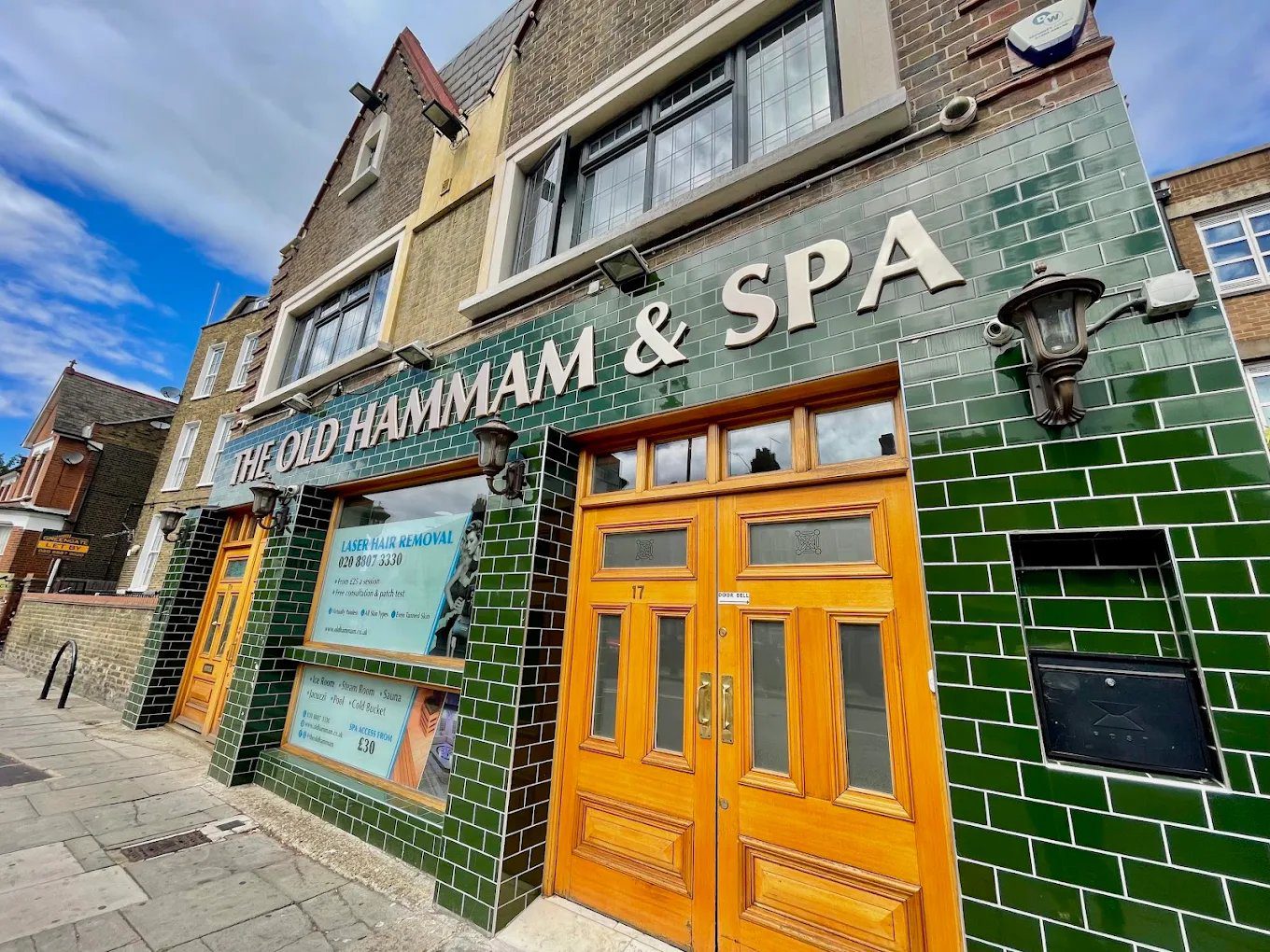
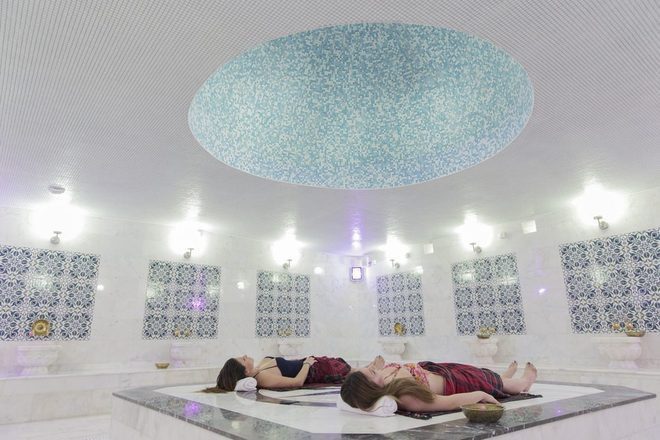
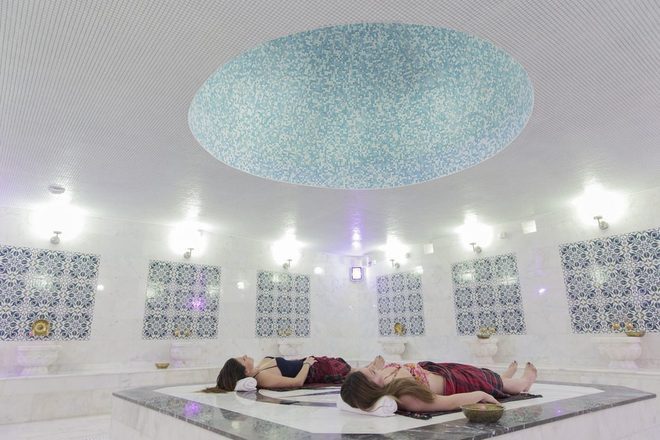
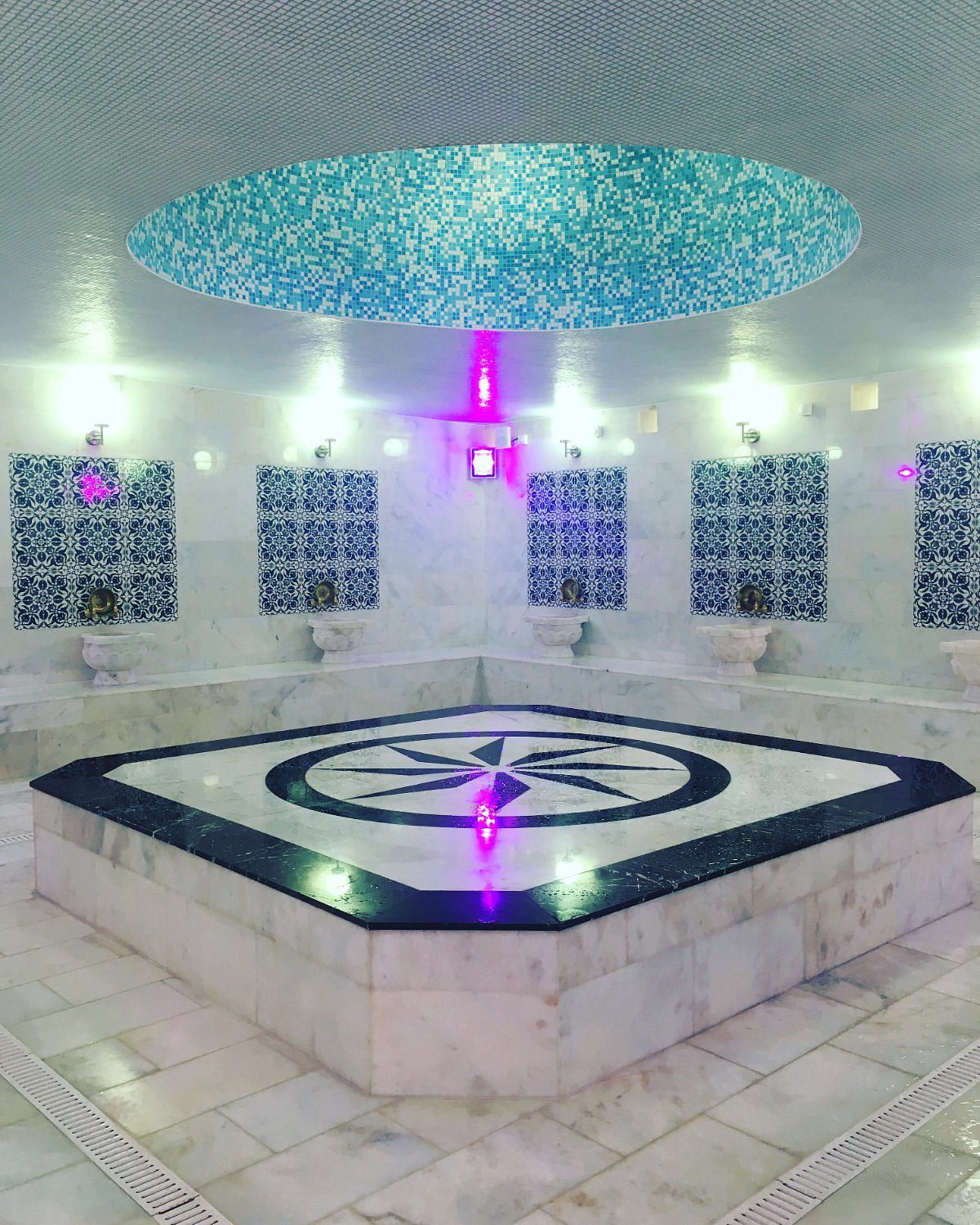
At The Old Hammam & Spa, the room itself tells you most of it. There are 13 marble basins (kurna), each with hot and cold taps and a gold bowl (tas) for pouring water, arranged around a large heated marble platform, the göbek taşı. You rest on that warm stone while the heat and steam soften your skin.
Then your therapist, the tellak, takes over. First a firm scrub with a coarse mitt called a kese, which lifts away dead skin in visible grey rolls slightly. It might look alarming the first time, but deeply satisfying after that. Then comes the rinsing with bowls of warm water and foam wash: a cloth bag is worked up into a thick cloud of soap lather, spread over you, and massaged in. In the Moroccan version, black olive soap goes on before the scrub, and a rhassoul clay mask follows it.
You can see how the ritual fits together on our Turkish and Moroccan hammam page, and there is a longer explanation of the foam stage in our guide to what a hammam massage is.
Nothing about a hammam is passive. That is the difference people do not expect.
What Is A Sauna?
A sauna is a small room heated with dry air, where you sit and sweat. That is the whole of it, and it is enough.
Cleveland Clinic puts traditional saunas at roughly 150 to 195°F which is about 65 to 90°C, with low humidity, usually under 20%. Our own dry sauna in Edmonton runs up to 85°C, so it sits comfortably in that range. The air is hot and dry, your skin stays mostly dry to the touch while you sweat, and your heart rate rises. Cleveland Clinic notes that this response resembles the effect of moderate exercise, and that sauna use may help with relaxation, sore muscles and pain relief.
Sessions are short. Ten to twenty minutes is a normal stint, then you come out, cool down, drink some water, and go back in if you want to. Most people do two or three rounds rather than one long one.
A review of the evidence published in Mayo Clinic Proceedings links regular Finnish-style sauna bathing with better cardiovascular outcomes and lower blood pressure. Worth knowing, and worth keeping in proportion: that research is almost entirely about dry Finnish saunas used regularly over years, not about a single visit, and it does not automatically transfer to steam rooms or hammams.
What Is A Steam Room?
A steam room is all about wet heat. A generator fills a sealed, tiled room with steam until the air is close to 100% humidity. Because of that, the temperature can be much lower than a sauna and still feel intense, typically around 40 to 45°C. Ours is eucalyptus-infused and reaches 45°C.
The reason a cooler room can feel hotter is simple physics. In dry air, your sweat evaporates and cools you. In saturated air, it cannot evaporate, so it sits on your skin and you keep heating up. Your skin stays wet the whole time, your airways get warm, moist air with every breath, and your pores open.
That moist air is why people head for the steam room when they feel congested or when their skin feels tight and dry. It is also why steam is such a good preparation for a scrub: ten to fifteen minutes in there softens the outer layer of skin so a kese mitt can do its job without dragging.
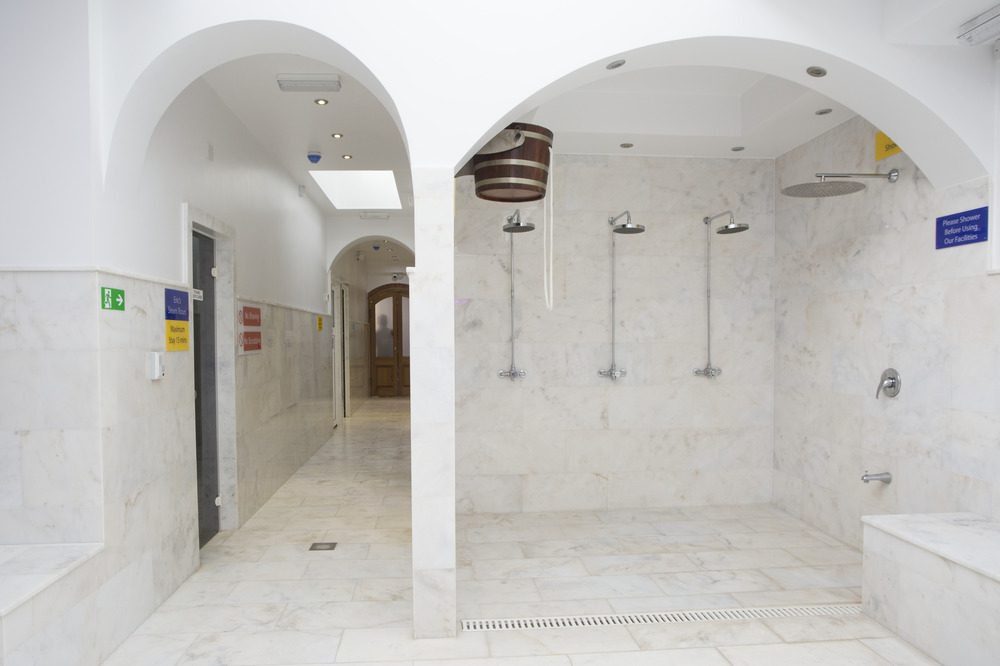
There is a full description of our steam room, sauna and the rest on the spa facilities page.
Turkish Bath Vs Sauna Vs Steam Room: A Comparison
| Information | Turkish bath (hammam) | Dry sauna | Steam room |
| What it is | A guided washing ritual on heated marble | A hot, dry room you sit in | A sealed room filled with steam |
| Temperature | Warm, humid room; the marble platform is heated | Up to 85°C here; 65–90°C generally | 45°C here |
| Humidity | High, from steam and hot water | Low, under 20% | Close to 100% |
| Do you do anything? | No – a therapist scrubs and washes you | No, you sit and sweat | No, you sit and breathe |
| Water involved | Lots. Bowls of water poured over you throughout | None, unless you pour it on the stones | Steam only |
| Exfoliation | Yes, with a kese mitt – the main event | No | No, though it softens skin ready for one |
| Typical time in it | 20 to 45 minutes of treatment | 10 to 20 minutes per round | 10 to 15 minutes |
| How skin feels after | Noticeably smoother; dead skin physically removed | Clean and warm, but unchanged in texture | Hydrated and softened, not exfoliated |
| Social side | Traditionally communal and unhurried | Quiet, usually individual | Quiet, usually individual |
A sauna and a steam room are both things you sit in, and they differ mainly in how the heat reaches you. A Turkish bath is something that is done to you, in a set order, and the heat is only the preparation for it.
Which One Should You Choose Between Turkish Vs Sauna Vs Steam?
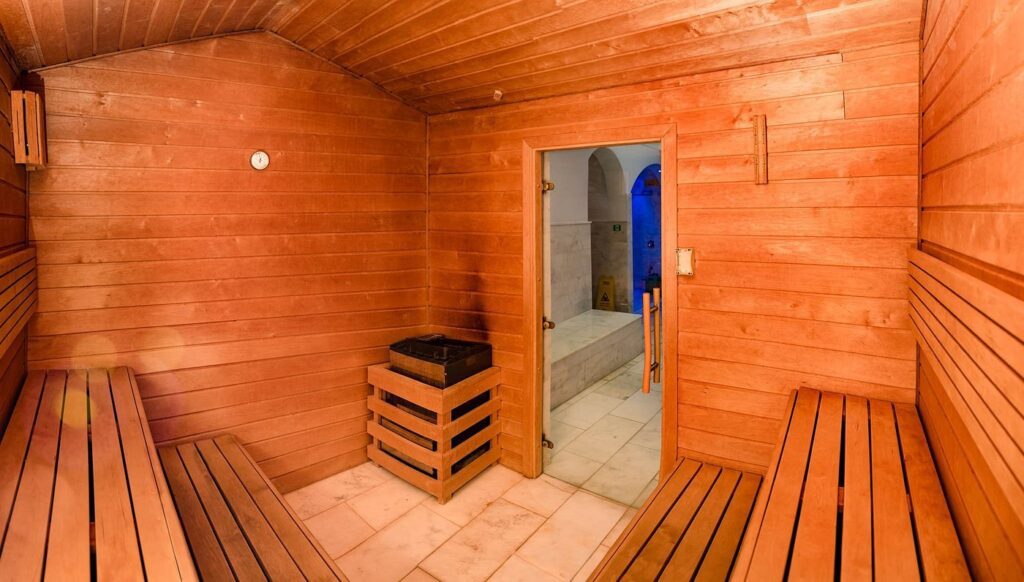
Choose a sauna if you want the strongest dry heat, you like the feeling of a really good sweat, or your muscles are sore and stiff. It is the simplest of the three and the one with the most research behind it.
Choose a steam room if dry heat makes you feel dried out, if your skin is tight, or if you want to breathe warm, moist air for a while. Many of our guests prefer it in winter, when central heating has been on them for weeks.
Choose a Turkish bath if what you actually want is to come out clean in a way a shower never manages. If your skin feels rough, if fake tan or sunscreen has built up, if you just feel grubby in a way you cannot scrub off yourself, that is hammam territory. The kese scrub is the only one of the three that physically removes anything.
And a word of reassurance, because people do worry about picking wrong. Cleveland Clinic’s Dr Amy Zack says there is no clear indication that wet heat is better than dry heat, or the other way round. It comes down to what you enjoy and what your body tolerates. Most of our guests do not choose at all: our spa and hammam packages include the hammam treatment plus access to the sauna, steam room, ice room, pool and jacuzzi, so you can move between them and find out which one is yours.
A few safety points that apply to all three. Drink water before and after. Keep your first sessions short. Do not stay in because someone else is staying in. Avoid alcohol beforehand. And if you are pregnant, have heart disease, have high or low blood pressure, or take medication that affects how you handle heat, check with your doctor first – Cleveland Clinic advises exactly that, and our own guidance is that expectant mothers should avoid intense steam, extreme heat and the sudden cold of the ice room.
Try all three in one afternoon and decide for yourself. Our spa and hammam packages at the Old Hammam & Spa in Edmonton London, start at £60 per person and include the full circuit including hammam, sauna, steam, ice room, pool and jacuzzi, with tea at the end. Call 020 8807 3330 to book, or buy a gift voucher if you would like to settle the argument for someone else.
Frequently Asked Questions
Is a Turkish bath the same as a steam room?
No, although they are often confused because a hammam room is warm and steamy. A steam room is a space you sit in. A Turkish bath is a treatment: warming, a kese scrub, rinsing with water from marble basins, and a foam wash, carried out by a therapist while you lie on a heated marble platform. The steam is one ingredient, not the whole thing.
Which is the hottest, a sauna or a steam room?
A sauna, by a long way – up to 85°C here, against 45°C in the steam room. The steam room can still feel just as intense, because at close to 100% humidity your sweat cannot evaporate and cool you down. Temperature on its own is a poor guide to how heat will feel.
Which is best for your skin?
For smoothness, the hammam, because the kese mitt physically removes dead skin rather than just softening it. Steam is the best preparation for that, which is why our ritual starts there. Neither a sauna nor a steam room on its own exfoliates. If your skin is sensitive, broken or sunburnt, tell us before you book, a firm scrub is not always the right call.
Can I use all three in one visit?
Yes, and that is how most visits here work. Start with ten to fifteen minutes in the steam room or sauna to warm through, have your hammam treatment, then use the sauna, pool, jacuzzi and ice room as you like afterwards. Going from the heat into the ice room at -15°C, or under the cold bucket shower, is a shock the first time and the reason a lot of people come back.
How long should I stay in a sauna or steam room?
Shorter than you think, especially at first. We suggest ten to fifteen minutes of warming before a treatment, and our steam room sessions are described as 15 minutes. Come out when you feel light-headed, uncomfortable or simply done, that is your body giving you information, not a test you are failing. Cool down, drink water, and go back in if you want another round.